Press Release: UOsaka Launches the SEAFOOD Quantum–HPC Platform

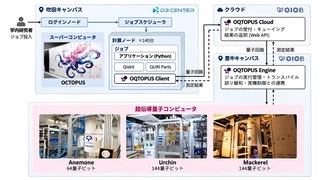
The University of Osaka has announced the launch of SEAFOOD, a new quantum–HPC collaborative computing platform developed jointly by the D3 Center and the Center for Quantum Information and Quantum Biology (QIQB).
SEAFOOD connects the OCTOPUS supercomputer operated by the D3 Center with superconducting quantum computers operated by QIQB through the open-source quantum cloud platform OQTOPUS.
The platform enables quantum and classical computations to be integrated within a single workflow and is scheduled to begin operation in December 2026.
SEAFOOD was developed based on collaborative research led by Susumu Date at the D3 Center and Hiroshi Ueda at QIQB, together with their colleagues. As a proof of concept, the team implemented a quantum-selected configuration interaction (QSCI) workflow combining quantum sampling with large-scale classical computation.
Read the full press release on the QIQB website
Institutional and Related Announcements
- Center for Quantum Information and Quantum Biology (QIQB), The University of Osaka
- D3 Center, The University of Osaka
- Date Laboratory, D3 Center, The University of Osaka
- D3 Center High Performance Computing System
- Quantum Software Research Hub (QSRH)
- Q-Portal, RIKEN
- Quantum Technology Innovation Hubs (QIH), RIKEN
- SIP3 Quantum, National Institutes for Quantum Science and Technology (QST)
International Science News and Press-Release Distribution
Secondary Coverage and Commentary
- The Quantum Insider — “SEAFOOD Puts OCTOPUS and Quantum Computers on the Same Menu”
- Mindplex — “Osaka team links quantum computers and a supercomputer in a first for Japan”
- Quantum Unzipped — “SEAFOOD Puts OCTOPUS and Quantum Computers on the Same Menu”
- Singularity Daily — Korean-language summary and commentary
- The Qubit Report — November 10, 2026 roundup
- AISeng Tech — Quantum Brief, November 11, 2026

Hiroshi Ueda is an Associate Professor at the Center for Quantum Information and Quantum Biology (QIQB), The University of Osaka.
His research focuses on tensor network methods, quantum many-body physics, quantum algorithms, and quantum-classical hybrid computation. He develops theoretical and numerical approaches for understanding quantum many-body systems and for designing quantum algorithms inspired by tensor network structures.